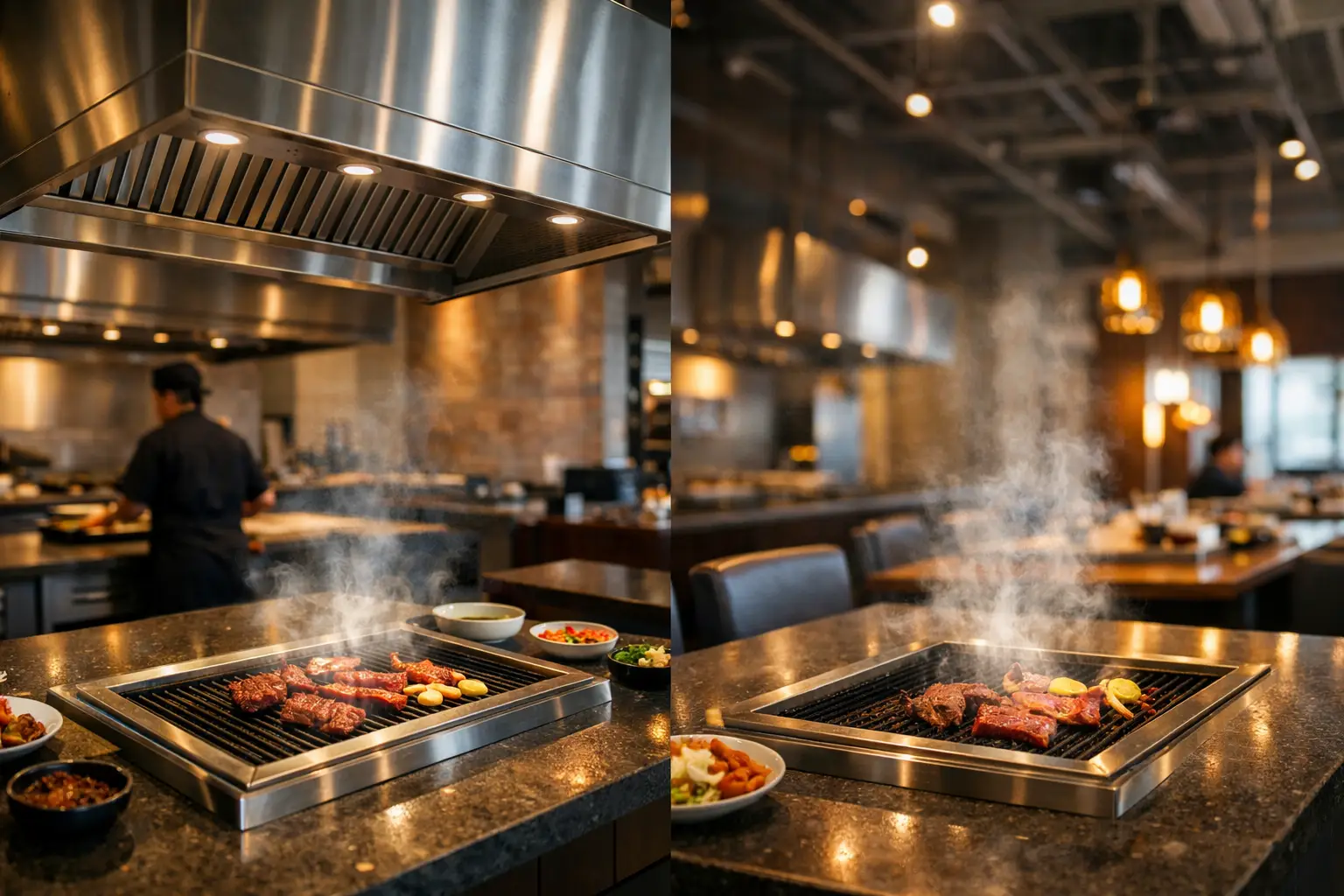
A teppanyaki table can look clean in a showroom and still create a difficult ventilation decision on a live restaurant floor. The direct answer to do smokeless grills need hoods is: often, yes. A smokeless design can reduce visible smoke, grease-laden vapor, heat, and odors at the source, but it does not automatically eliminate the need for a commercial exhaust hood or other approved ventilation system.
For a restaurant, hotel, or hospitality project, the final answer comes from the cooking process, the installed equipment configuration, the local authority having jurisdiction, and the building's mechanical design. Treat “smokeless” as an equipment-performance description, not as a blanket exemption from ventilation requirements.
What “smokeless” means for commercial grill tables
A commercial smokeless teppanyaki or hibachi grill table is typically designed to manage cooking emissions more effectively than an open, conventional grill arrangement. Depending on the model, this may involve integrated downdraft collection, perimeter capture, filtration components, controlled airflow, or a cooking surface and grease-management design intended to limit flare-ups and airborne grease.
That can materially improve guest comfort. It may reduce the plume that rises between the chef and guests, help protect nearby finishes, and support the interactive experience that makes teppanyaki and hibachi dining commercially valuable.
However, reduced smoke is not the same as zero emissions. High-heat searing of protein, oil use, sauces, food moisture, grease vapor, and combustion products from gas equipment can still affect indoor air quality. The equipment also adds sensible heat to the dining room or kitchen, which must be addressed through the overall HVAC design.
Do smokeless grills need hoods under code?
A smokeless grill may need a hood, but the specific requirement is determined locally. In many commercial applications, equipment that produces grease-laden vapors is evaluated for a Type I hood or an engineered alternative accepted by the local code official. Equipment that produces heat, steam, or odors without grease-laden vapors may fall under different ventilation provisions.
The practical point is that the label on the equipment does not make this determination by itself. The reviewing parties will typically consider the appliance, fuel source, menu, operating temperatures, cooking method, airflow path, fire-protection arrangement, and installation location.
A gas-fired hibachi grill table generally deserves especially early review because combustion adds another variable to the ventilation and makeup-air discussion. An electric teppanyaki grill may reduce combustion-related concerns, but it can still generate grease vapor and substantial heat during service. Neither fuel choice should be assumed to be hoodless without written confirmation for the project.
Why menu planning changes the answer
A low-oil demonstration menu is not equivalent to a full dinner service with steak, seafood, fried rice, butter, sauces, and repeated high-temperature cleaning cycles. The same grill table can perform differently depending on how it is used.
Before selecting a ventilation approach, document the proposed menu and peak service pattern. Include the food types, anticipated oil and fat use, cooking temperatures, number of active cooking zones, hours of operation, and whether chefs will cook continuously in front of guests. This gives the mechanical engineer and code reviewer a basis for evaluating the actual cooking load rather than a generic equipment description.
Hooded, ventless, and downdraft are not interchangeable
These terms are sometimes grouped together, but they describe different strategies.
| Approach | What it does | Key project consideration | |---|---|---| | Overhead Type I hood | Captures grease-laden vapor and heat above the cooking surface | Requires duct, exhaust fan, fire protection, makeup air, and coordinated clearances | | Downdraft or integrated capture | Pulls emissions toward a collection path near the grill | Performance depends on grill design, cooking load, filters, and installation conditions | | Recirculating or ventless system | Filters and returns air to the space in approved applications | Must be specifically evaluated for the appliance, menu, filters, maintenance, and local approval | | Type II hood | Handles heat, steam, and certain non-grease vapors | It is not automatically suitable for grease-producing cooking |
An integrated smokeless system may be part of a hoodless or reduced-hood concept, but it is not automatically a substitute for an overhead hood. Capture performance can change with cross-drafts from supply diffusers, open doors, nearby air-conditioning outlets, or the movement of staff and guests around an island cooking table.
For front-of-house teppanyaki installations, that distinction matters. The system needs to control emissions without creating uncomfortable drafts at the guest counter or interfering with the chef's working area.
Specify the grill and ventilation system together
The costly mistake is ordering the grill table first and asking the mechanical team to solve ventilation afterward. By then, ceiling structure, duct routes, electrical capacity, gas piping, and seating layout may already be fixed.
Start with the equipment drawing. A useful project package identifies the cooktop dimensions, overall table footprint, utility connection locations, service-access areas, equipment weight, proposed fuel type, and any integrated smoke-control components. Then coordinate the ventilation concept with the architect, MEP engineer, fire-protection designer, contractor, and local reviewing authority.
For a custom teppanyaki grill table, small design decisions can affect the installation. The position of a downdraft intake, the depth of a guest counter, the canopy geometry, and the location of an access panel can all influence capture, cleaning access, and field coordination.
Questions to resolve before releasing an order
A proper equipment and ventilation review should answer these questions in writing:
- What foods will be cooked, and at what peak volume?
- Is the selected grill gas or electric, and what utilities are required?
- Does the proposed configuration call for an overhead hood, integrated capture, or another approved system?
- Where will exhaust, makeup air, and conditioned supply air enter the space?
- What fire-suppression and interlock requirements apply to the final installation?
- Who will approve the ventilation approach before fabrication and site work begin?
This is not paperwork for its own sake. It protects the opening schedule. A late requirement for ductwork or a larger makeup-air unit can affect ceiling design, roof penetrations, electrical work, permit timing, and the dining-room layout.
Operational issues after installation
Ventilation is not only a permit-stage topic. A smokeless grill table must be operated and maintained as part of the restaurant's daily system.
Grease trays, filters, and capture channels need cleaning at intervals that match the cooking load. Filters that are not maintained can reduce airflow and compromise the very smoke-control performance the project depends on. Staff should also understand that excessive oil, overloaded cooktops, or blocked intake paths can change the results during a busy service.
Makeup air deserves equal attention. Exhausting air without a balanced replacement-air plan can create negative pressure, make doors difficult to open, pull odors into guest areas, and reduce capture performance. Good ventilation design protects the dining experience as well as the equipment.
Documentation and certification review
For procurement teams, request documentation for the exact model and configuration under consideration. Cookeryaki states that its products hold NSF and CE certification, but certification documentation should always be requested and reviewed on a model-specific basis. Custom fabrication, fuel type, electrical configuration, integrated ventilation components, and destination requirements can affect what documents are relevant to your project.
Ask for dimensional drawings, utility schedules, installation requirements, operating guidance, and the available model-specific certification documents before final approval. If a hoodless or alternative ventilation approach is proposed, obtain written acceptance from the appropriate local authority and coordinate it with the building engineer rather than relying on a verbal assumption.
A well-planned smokeless teppanyaki or hibachi installation can support interactive cooking while controlling smoke, heat, and maintenance demands. The right question is not whether a grill is marketed as smokeless. It is whether the complete grill, menu, ventilation, and building system have been designed to work together. For a project-specific drawing review or equipment brief, contact Cookeryaki at marketing@cookeryaki.com.