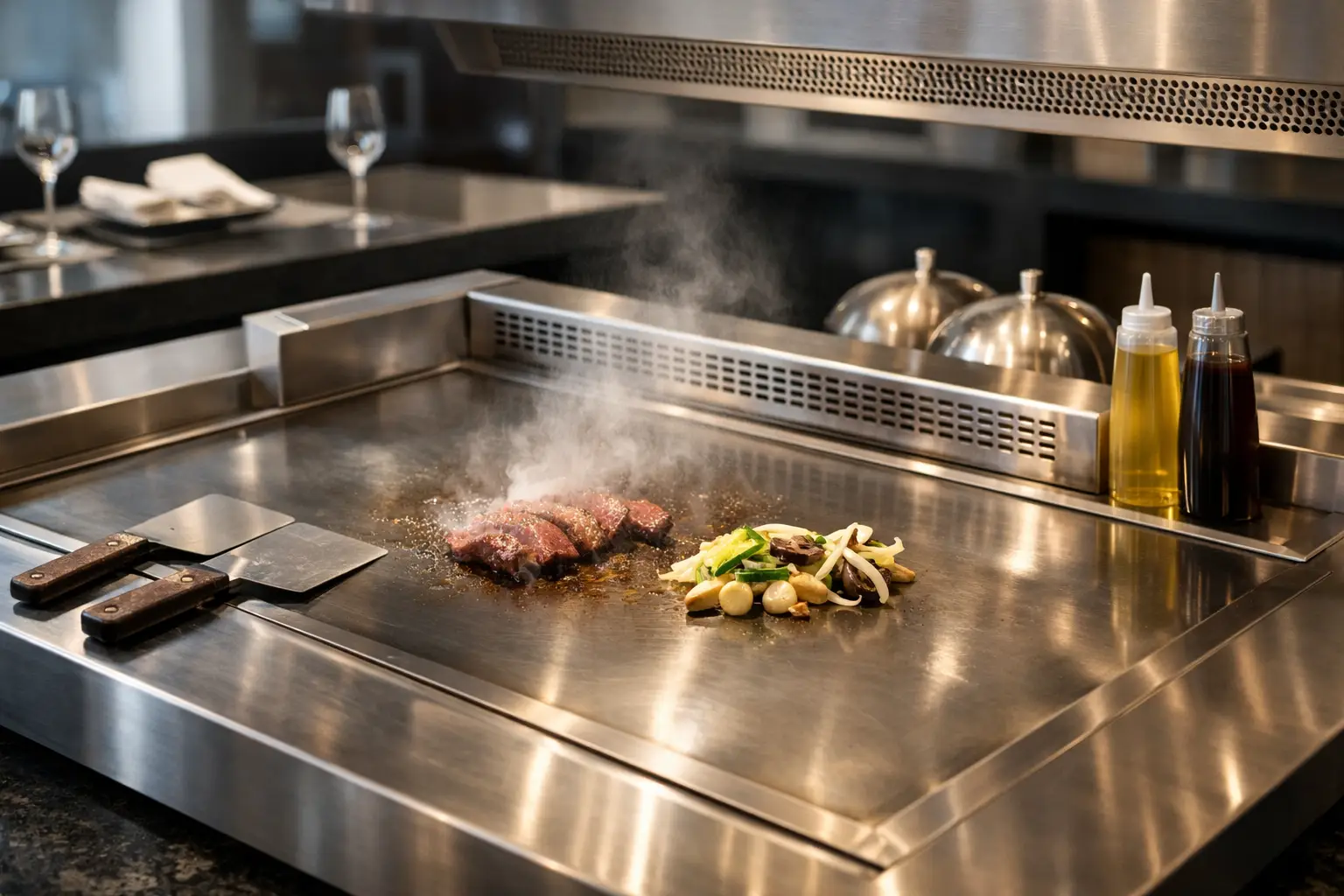
Stainless steel is not a marketing shortcut. In a teppanyaki kitchen it affects cleaning, access, heat exposure, appearance, and how the table holds up after repeated service. The grade and construction still need to be confirmed on the drawing and quotation.
Hygiene and daily cleaning
A smooth, well-finished work surface is easier to scrape, wash, inspect, and maintain than a complicated decorative assembly. Ask where grease collects, how panels open, and whether staff can reach the areas behind the cooktop. Cookeryaki’s commercial grill pages emphasize hygienic steel surfaces and modular components; those details are more useful when tied to a cleaning routine.
Heat and structure
The cooktop, insulation, frame, controls, and access doors work as one system. A stainless exterior does not by itself guarantee stable heat or a long service life. Request the material specification, plate thickness, internal support, heat-zone layout, and service access.
Finish without losing the working logic
Cookeryaki lists marble, Corian, glass, acrylic, stainless steel, and wood finish options for custom tables. Use decorative finishes where guests see them, but keep hot zones, grease paths, access doors, and ventilation interfaces practical.
For an international project, pair the stainless specification with the required NSF/CE documentation for the exact model, plus the destination electrical or gas requirements. This avoids treating a general product statement as a complete compliance file.
Stainless-steel teppanyaki grill FAQ
Is every stainless-steel grill equivalent?
No. Material grade, thickness, weld quality, internal reinforcement, finish direction, edge treatment, and the design of grease and cleaning paths all affect performance. Ask the supplier to identify the materials used in the quoted model.
Why does cleanability depend on design?
A durable surface is only useful when staff can reach the cooktop perimeter, grease collection area, filters, panels, and service components. Smooth joints, removable parts, drainage, and access panels should be evaluated with the daily cleaning routine.
What should a buyer verify before approval?
Review the final drawing, cooktop dimensions, heat zones, utility schedule, extraction method, finish samples, service clearances, and model-specific NSF or CE documents. Stainless steel is one part of a complete commercial specification.
Talk to Cookeryaki
For a project review, send the destination country, floor plan, seating count, preferred fuel, and any site drawings to marketing@cookeryaki.com. Cookeryaki can review a configuration before quotation.