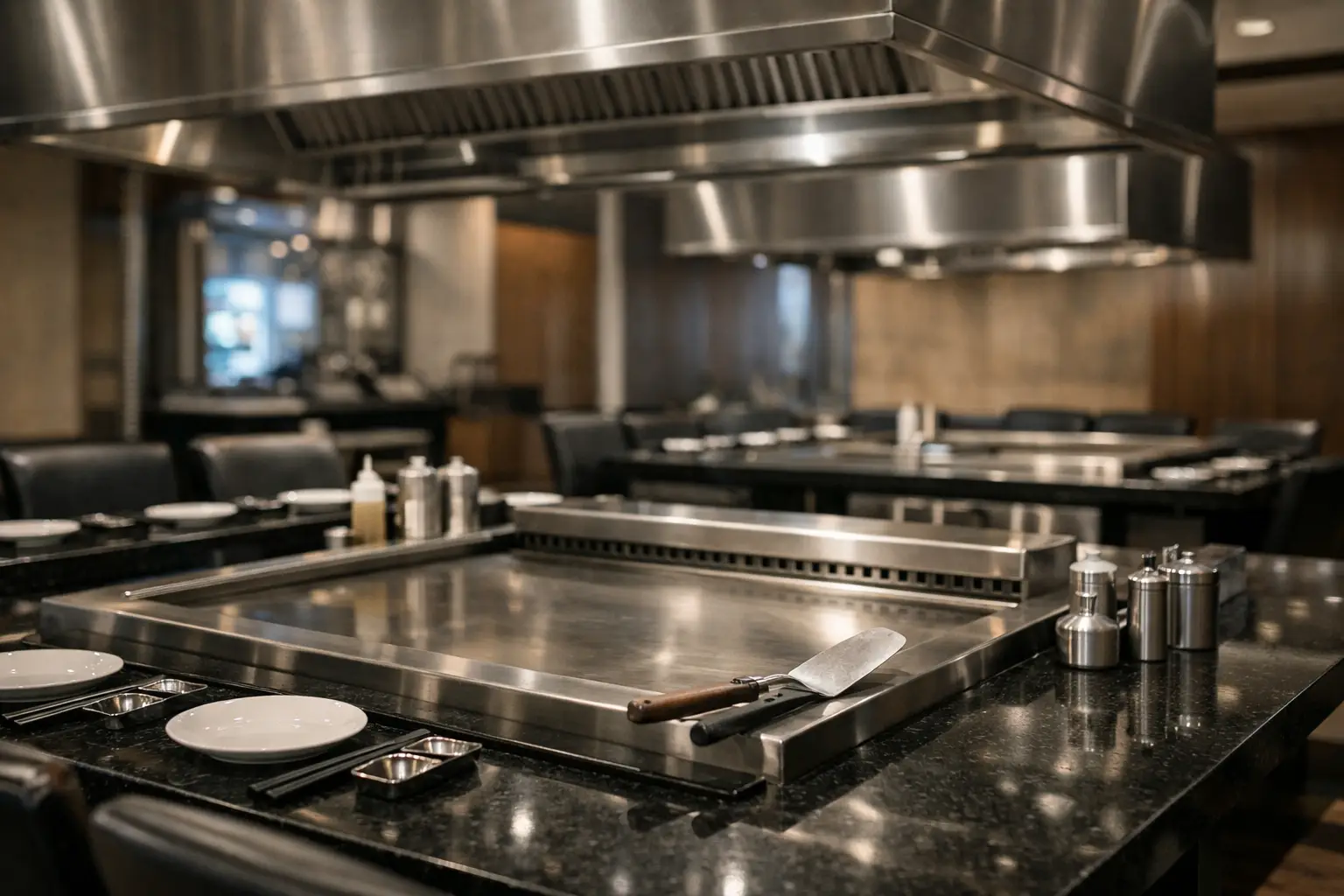
A commercial hibachi table is part of the restaurant’s service line, not a piece of loose furniture. It has to fit the room, give the chef a workable cooking surface, and keep guest sightlines clear. Cookeryaki builds commercial teppanyaki and hibachi-style tables for restaurants, hotels, distributors, and custom projects.
Start with the room and service
Before choosing a shape, confirm covers per seating, chef position, aisle width, extraction route, and where utilities can enter the table. Cookeryaki lists round, U-shaped, island, and other custom layouts, with branding and finish options including marble, Corian, glass, acrylic, stainless steel, and wood.
Choose the heating and smoke-control package
Gas and electric tables solve different site problems. Gas can suit projects that already have the required fuel infrastructure; electric can be easier where gas is restricted or unavailable. For open kitchens, the exhaust approach matters just as much as the cooktop. Cookeryaki describes updraft hood, downdraft, and ductless/smokeless options, including its Airwork six-stage filtration system. The final arrangement still needs to be checked against the local mechanical and fire requirements.
Specify documentation before the quotation
Ask for the drawing, table dimensions, power or gas data, extraction assumptions, finish schedule, and installation responsibilities. Cookeryaki says its product range carries NSF and CE certifications; request the model-specific documents needed by the destination market rather than assuming every configuration has the same file set.
The company operates its own factory and supports projects from drawing review through production and shipment. That is useful when a standard table will not fit the room.
Watch the Cookeryaki global brand film for a short look at the equipment and manufacturing style.
Commercial hibachi table FAQ
What should be fixed before requesting a quotation?
Confirm the seating count, table shape, cooking-surface size, heat source, extraction concept, utility entry points, finish, delivery route, and maintenance access. A floor plan is more useful than a product photo because it shows aisles, columns, hoods, doors, and service paths.
Does a smokeless hibachi table automatically eliminate the hood?
No single answer applies to every site. Integrated extraction can capture smoke and grease close to the cooktop, but the local authority, menu, room heat load, fire strategy, and selected model determine whether additional exhaust is required.
How should NSF and CE documents be checked?
Ask Cookeryaki for the certificate or declaration that matches the exact model and configuration being quoted. A custom finish, heating package, voltage, or control change should be reviewed before assuming the same documentation applies.
Talk to Cookeryaki
For a project review, send the destination country, floor plan, seating count, preferred fuel, and any site drawings to marketing@cookeryaki.com. Cookeryaki can review a configuration before quotation.
- Cookeryaki official website
- Commercial grills and pizza ovens
- Hibachi restaurant equipment
- LinkedIn · Instagram · YouTube · Facebook
Project notes are reviewed against the current Cookeryaki product pages before quotation.